
Systems & Structural Repair
Repair work gets diagnosed before it gets priced.
Structural framing, subfloor and joist work, water, storm and fire damage — investigated properly and quoted from the findings, not from a phone description.
Why this category exists
Every renovation we lose money on started with a bad diagnosis.
A homeowner calls because 'the floor feels bouncy near the kitchen sink'. A less careful contractor books it as a subfloor repair, gives a rough price, arrives with a saw, and finds the problem is actually a slow leak that has rotted three joists and a portion of the sill plate for eight feet. The scope triples on day one. Now everyone is angry. We treat repair scopes as their own category because they deserve a proper diagnostic phase before any price is committed.
Scope
Repair scopes we handle
Structural & framing
Load-bearing wall repair, beam and column additions, sister joists, post and pier work in crawl spaces, and rafter or truss repair. Structural engineer involved for anything that requires an engineered attachment or a permit.
Subfloor & joists
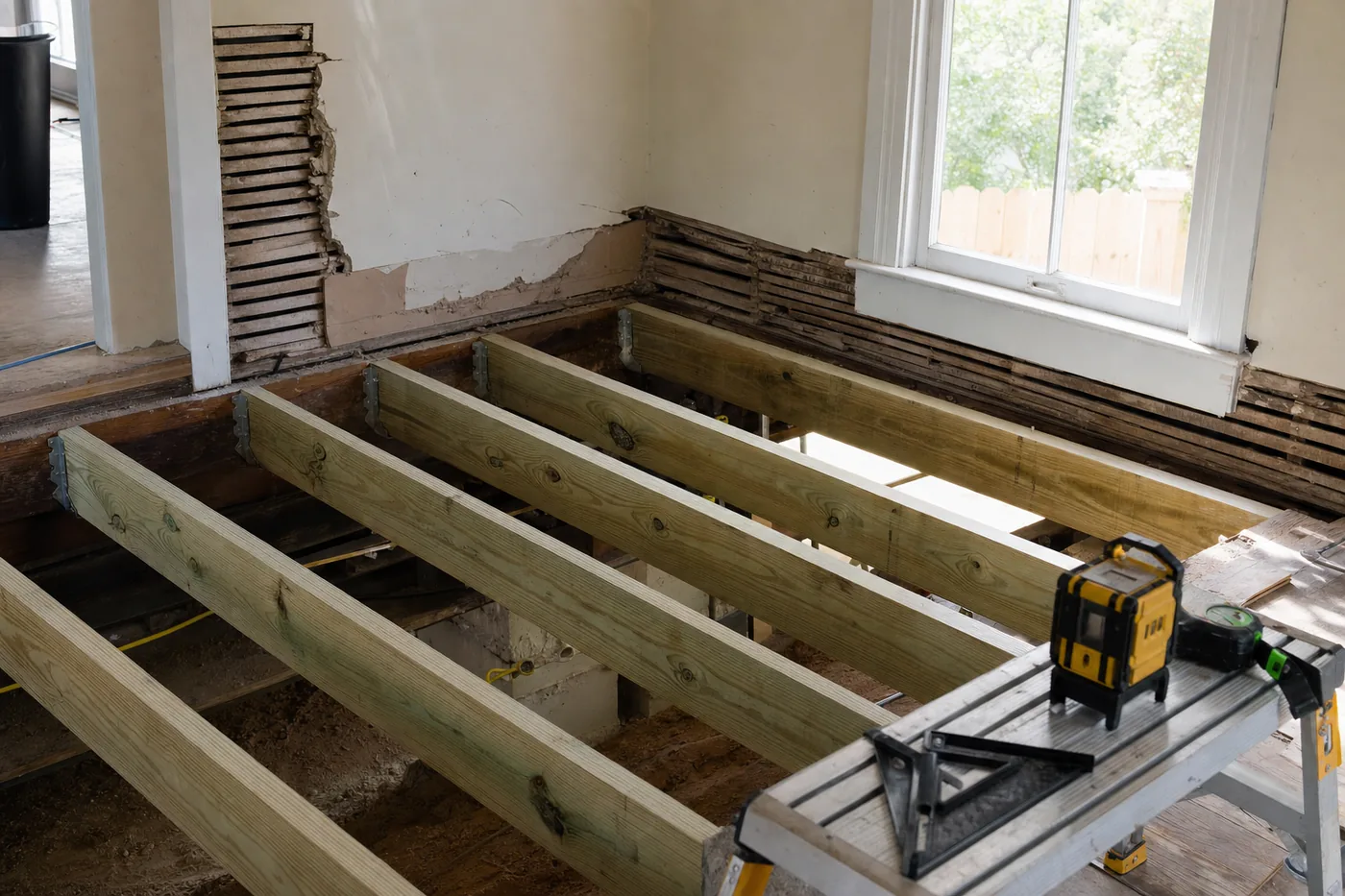
Rotten subfloor removal and replacement, joist sistering with pressure-treated lumber to code, and full joist replacement where sistering isn't enough. Common on kitchen and bathroom projects where water has been running behind cabinets or under a shower pan for years.
Water & storm damage
Storm-band damage, plumbing failures, roof failures, and slow leaks that have compromised finishes and framing. Dry-out coordinated with a restoration partner, then reconstruction. Documented for insurance from the first walk.
Fire & smoke damage
Structural repair after fire, smoke remediation, and rebuild coordinated with the insurance adjuster. Includes soot remediation on adjacent materials and full reconstruction of affected rooms.
Insurance-claim work
Estimates delivered in Xactimate or the adjuster's preferred format. Scope negotiated directly with the carrier. Client keeps their focus on their family; we handle the contractor side of the claim.
Termite & rot repair
Removal and replacement of members compromised by termite or rot damage. Coordination with the pest control company for treatment prior to reconstruction.
Atmospheric image representative of our structural repair work.
How we do it
How a repair scope moves
01. Assessment agreement
For repair work we lean on the assessment agreement even more than on renovation projects. A paid, limited-scope agreement lets us open a wall, pull up a section of subfloor, or crawl the space to actually see what's happening — without pretending we can diagnose it from a photo.
02. Diagnosis
Written findings delivered to the homeowner: what we found, what it means, and what the range of repair options looks like.
03. Scope & contract
A fixed-scope contract based on the diagnosis. Contingency line-items called out separately for anything we can predict as possibly-encountered but not confirmed.
04. Repair execution
Structural repairs made first, envelope closed, finishes rebuilt. Inspections at framing, MEP rough, and final.
05. Documentation
For insurance claims: photos before, during, and after. Written scope. Warranty on the workmanship. All delivered as a file the homeowner can hand to the carrier.
Representative work
Repair scopes we handle regularly
These are generic scope examples drawn from work we have completed across Hampton Roads. Specific homeowner details are withheld to respect client privacy.
Example scope
Bathroom water damage rebuild
Slow leak from an upstairs shower pan degraded the ceiling below, sistered two joists, replaced subfloor at the wet section, and rebuilt the ceiling, insulation, and finishes in the room below. Coordinated with the homeowner's insurance carrier.
Example scope
Storm-damage envelope & interior repair
Hurricane band tore a portion of siding and roofing off, driving water into two rooms of the second floor. Dry-out by a restoration partner, then reconstruction — new sheathing, new insulation, new drywall, new floors in the affected rooms. Six to ten weeks depending on the room count.
Example scope
Sagging floor structural repair
Ranch home with a noticeable floor slope through the middle of the house. Diagnosis showed insufficient centre-beam support after a previous owner had removed a load-bearing partition. Scope re-established the load path with a new engineered beam and posts, then re-levelled the floor system to grade.
Example scope
Fire & smoke reconstruction
Kitchen fire contained to the kitchen but with smoke damage through the main floor. Structural repair in the kitchen, smoke remediation across the affected zone, and a full rebuild of the kitchen and adjoining living areas. Insurance-coordinated end to end.
Common questions
Systems & repair FAQ
Do we work directly with insurance?
Yes — we produce estimates in the format the carrier prefers (usually Xactimate), meet with the adjuster on site, and negotiate scope. We don't inflate scope to fit insurance and we don't cut scope to fit an under-scoped claim. Where the carrier's estimate is short, we document why and advocate for the correction.
Can we diagnose a repair over the phone?
Very rarely honestly. Most repair scopes require opening something up to see what's happening. That's what the assessment agreement is for — it lets us do the investigation properly before committing to a price.
What's the timeline on storm-damage work?
Depends on scope and carrier response time. A single-room water repair: three to six weeks from claim approval. A multi-room storm reconstruction: eight to sixteen weeks. Fire reconstruction usually longer because engineering and remediation both take time.
What is a realistic investment for structural repair?
Repair scopes vary enormously — a bathroom subfloor repair might be $3,500; a house-wide floor system re-level with new engineered beam might be $45,000. The assessment agreement gets us to a specific number.
Are repair scopes covered by warranty?
Yes — our workmanship warranty applies to repair work exactly like it applies to renovations. Manufacturer warranties on materials pass through as normal.